
Master-Level CAS in Education Governance & Institutional Performance
Certificate of Advanced Studies in Education Governance & Institutional Performance
This programme is designed for educational leaders and managers who wish to strengthen their strategic governance capacity, enhance quality assurance systems, and optimise organisational performance in the context of modern education. Learners are equipped with policy analysis, governance framework design, and performance evaluation approaches, thereby improving transparency, accountability, and organisational-level leadership capacity.
Upon graduation, learners may be considered for credit recognition and partial tuition offset in related Master’s programmes such as:
- Master of Advanced Studies in English–Medium Instruction
- Master of Advanced Studies in Educational Accreditation and Quality Management
- Master of Advanced Studies in Learning Experience Design
- Master of Advanced Studies in Education Management and Innovation Pedagogy
- Master of Advanced Studies in TESOL
SwissCAS⁺ is a Certificate of Advanced Studies system offered by Swiss Information and Management Institute (SIMI), allowing credit accumulation for possible progression to a Master of Advanced Studies (MAS), subject to the applicable academic and progression policies.


SwissCAS⁺ - Certificate of Advanced Studies (CAS), Switzerland
What do you get?
SwisCAS
SwissCAS is a continuing education qualification within the Swiss higher education continuing education framework.
Credits Toward MAS
Graduates of SwissCAS may be eligible for credit recognition toward selected MAS (Master of Advanced Studies) pathways.
Tuition Credit
Subject to the applicable policy, part of the tuition already paid may be applied as internal tuition credit when progressing to a Swiss MAS.
Scholarship
Scholarship and tuition support opportunities may be available, subject to applicable policies and terms.
Certificate of Advanced Studies (CAS), Switzerland
Programme Details
1. Understand major contemporary issues affecting education policy and their impact on institutions
1.1 Analyse recent changes in educational theory, policy, and practice
This section requires consideration of recent changes in educational thinking and in the way education is delivered. This includes changes in how learners are understood, adjustments in education management policy, and innovation in teaching methods and programme delivery.
Education is currently shifting from a knowledge-transmission model to a competency-based model. Lifelong learning has become an important trend. Technology, especially artificial intelligence, is increasingly being integrated into teaching and learning processes. These changes not only affect training programmes but also influence how educational institutions operate.
1.2 Evaluate the factors influencing educational theory, policy, and practice
It is necessary to analyse the factors shaping contemporary education. These include funding mechanisms and financial resources for education, as well as levels of participation and learner motivation. Learner profiles, including age, academic background, and professional experience, also play an important role.
In addition, the application of technology in teaching and learning management is changing the way programmes are designed. The growing demand for skills development in response to labour market needs is increasing. Approaches that help attract and sustain learner engagement are becoming important factors in determining educational effectiveness.
1.3 Analyse the impact on stakeholders
Changes in educational theory, policy, and practice directly affect many different groups. Learners need flexible, practical programmes with clear career value. Educators must adapt to new teaching methods and higher technological expectations. Funders, sponsors, and partners are concerned with educational effectiveness and the sustainability of delivery models.
Educational institutions need to adjust their development strategies to remain responsive to an increasingly competitive education environment. Partners and regulatory bodies require transparency, standardisation, and quality assurance. A clear understanding of the expectations and needs of each group helps institutions build effective and sustainable educational models.
2. Understand the impact of policy change on educational provision
2.1 Discuss the impact of key policy changes on teaching, learning, and assessment
Changes in education policy can directly affect how teaching is organised, how learning takes place, and how learning outcomes are assessed. When policy changes occur, education and training programmes may need to be reviewed and updated to align with new standards, the requirements of relevant national qualifications frameworks, and other applicable external quality expectations.
In teaching, policy changes may encourage the adoption of learner-centred approaches, greater use of technology-enhanced learning, and stronger alignment with competence-based or outcomes-based approaches to teaching and learning. In learning, learners may need to adapt to a wider range of assessment methods, including competence-based assessment, assessment aligned to learning outcomes, and self-assessment. In assessment, standardisation, transparency of procedures, and clear marking criteria may become increasingly important and, in some contexts, may be required under institutional, awarding body, or regulatory frameworks.
2.2 Describe the requirements for continuous improvement
Continuous improvement is an essential requirement for modern educational organisations. This includes establishing mechanisms for gathering learner feedback, applying quality assurance measures across educational provision, and promoting organisational development through a quality improvement-oriented approach.
Continuous improvement requires the involvement of the whole organisation, including senior leadership, teaching staff, and support staff. The quality of teaching, learning, and assessment should be monitored and reviewed regularly. The relationship between teaching evaluation, learner assessment, analysis of learner needs, and programme review plays an important role in this process. Teaching, learning, and assessment methods should be reviewed regularly to support consistency, effectiveness, and transparency.
2.3 Analyse the measurement of continuous improvement
Measuring continuous improvement requires an organisation to identify areas for development and evaluate current performance. This includes gathering feedback from relevant stakeholders, identifying improvement objectives, and allocating appropriate resources to support analysis and implementation.
The process may include identifying the causes of current performance levels, proposing and testing improvements, evaluating the results of interventions, and making appropriate changes. Performance indicators should be established, monitored, and reviewed as part of a continuous improvement cycle in order to support sustainable development.
2.4 Evaluate quality management models and theories in educational provision
Quality management models and related theories provide a useful framework for improving the effectiveness of educational provision. For example, Force Field Analysis can help organisations understand the factors that support or hinder change. Six Sigma can be used to reduce inefficiencies, variation, and process weaknesses. Total Quality Management emphasises the development of a quality culture across the whole organisation. The PDCA cycle highlights continuous review through planning, implementation, checking, and improvement.
The application of these models should be appropriate to the context of the educational organisation and should support an effective balance between standardisation, quality assurance, and flexibility in programme delivery.
3. Understand the development of education systems in response to legal requirements
3.1 Explain the relationship between recent developments in education systems and legal and regulatory frameworks
Education systems are significantly shaped by legal requirements and national policy. New laws, regulations, and regulatory frameworks can reshape educational objectives, curriculum structures, professional standards, and quality assurance arrangements.
These developments are often influenced by national policy priorities, economic conditions, and broader social change. For example, reforms in national education policy or curriculum frameworks may require adjustments to teaching content. Policies promoting vocational education and training aligned with employer needs may strengthen the role of VET systems and employer engagement. Professional and teacher education standards may also be updated to remain responsive to labour market needs.
As a result, the development of education systems and legal frameworks is closely interconnected and mutually influential.
3.2 Evaluate how current educational practice has changed under the impact of legal requirements
New laws and regulations can significantly change the way education is organised and delivered. Educational programmes are increasingly designed to be more flexible, integrated, and structured around modules or units. In some systems, this can enable learners to accumulate credits and personalise their learning pathways.
Contemporary education also places increasing emphasis on inclusion, helping to ensure that learning opportunities are accessible to all learners. Holistic approaches that combine knowledge with practical application are becoming more important. Collaboration between educational institutions and industry is also becoming a key factor.
In addition, distance learning and blended learning models are increasingly being incorporated into policy, regulatory, and quality assurance frameworks in many jurisdictions, thereby expanding access to education. These changes show that educational practice continues to adapt in response to legal requirements and changing development contexts.
Assessment and Reference Materials
Assessment Requirements
To achieve a pass for this module, learners must provide evidence demonstrating that they have successfully achieved all learning outcomes and met the full assessment criteria.
Assessment Scope
Learners are required to meet Learning Outcomes 1 to 3 and the assessment criteria associated with each learning outcome.
The assessment takes the form of an academic report of approximately 4,500 words.
Indicative Reading List
Avis J, Fisher R and Thompson R (eds). (2009). Teaching in Lifelong Learning: A Guide to Theory and Practice. Open University Press.
Cohen L, Manion L, Morrison K and Wyse D. (2017). A Guide to Teaching Practice, 5th edition. Routledge: London.
Illeris K. (2018). Contemporary Theories of Learning: Learning Theorists in Their Own Words. Routledge: London.
Johnston R, Clark G and Shulver M. (2012). Service Operations Management: Improving Service Delivery. Pearson: London.
Oakland J. (1995). Total Quality Management. Butterworth-Heinemann Ltd: Oxford.
Website Links
Department for Business, Energy and Industrial Strategy
https://www.gov.uk/government/organisations/department-for-business-energy-and-industrial-strategy
Department for Education
https://www.gov.uk/government/organisations/department-for-education
Dylan Wiliam Professional Development Materials
www.Dylanwiliam.net
Centre for Research in Lifelong Learning
www.crll.org.uk
Excellence Gateway
www.excellencegateway.org.uk
Informal Education
www.infed.org
Geoff Petty Online Teaching Resources
www.geoffpetty.com
Office for Standards in Education
www.ofsted.gov.uk
Society for Education and Training
https://set.et-foundation.co.uk/
Qualification Awarded
Upon graduation, students will receive:
- Master-Level CAS in Education Governance & Institutional Performance
Programme owner and awarding institution of SwissCAS⁺: Swiss Information and Management Institute
Entry Requirements
- A Bachelor’s qualification in Majors from accredited universities; or a Level 6 EQF diploma or an equivalent qualification from organizations that are authorized to issue qualifications and have been accredited.
- Applicants who do not hold a university degree but have more than 5 years of work experience may be considered for special admission through the APEL process.
- English proficiency must be at least CEFR (Common European Framework of Reference) level B2 or IELTS 5.5
Learning Mode
Learners attend Live Class directly with lecturers from Swiss Information and Management Institute under the Live Class Direct™ model. Upon successful completion of the programme, learners receive qualification from Swiss Information and Management Institute.
The Live Class Direct™ model enables learners to study directly with Swiss Information and Management Institute, without franchise delivery or intermediaries. This helps maintain the original programme structure, ensure direct academic access, and reduce third-party delivery risks.
SwissCAS⁺
CREDIT AND TUITION OFFSET
SwissCAS⁺ may be eligible for credit recognition and tuition offset toward selected Master of Advanced Studies (MAS) pathways, subject to the applicable academic and progression policies.
Master of Advanced Studies in Educational Accreditation and Quality Management
The Master of Advanced Studies in Educational Accreditation and Quality Management – SwissUK® is designed to respond to the growing need for expertise in accreditation, quality assurance, and continuous improvement within higher education institutions worldwide.
The programme is designed with reference to relevant UK occupational standards, including Academic Professional and Quality Practitioner, while being delivered within a Swiss private education context. Where applicable, any UK-regulated qualification components should be identified separately by their awarding organisation and qualification title.
The programme aims to develop professionals in educational accreditation and quality management who are able to support internal quality assurance (IQA), engage effectively with external quality review processes, contribute to continuous improvement, and understand quality management and accreditation models at both institutional and programme levels.
See more: HERE
Master of Advanced Studies in English–Medium Instruction Dual Qualification
The Master of Advanced Studies in English-Medium Instruction Dual Qualification programme is designed for candidates who aim to expand their professional prospects by developing in-depth expertise and teaching capacity in English, particularly in bilingual institutions, international programmes, and educational environments where English is used as the medium of instruction. At the heart of the programme is the development of academic teaching competence in English, curriculum design and implementation, learning assessment, and innovation in teaching methods aligned with the modern educational context.
The programme enables learners to master the English-Medium Instruction (EMI) model not only from a language perspective, but also in terms of pedagogical and academic competence, allowing direct application in the teaching of specialised subjects, enhancing training quality and the learner experience in international environments. The programme supports the professional transformation of educators across diverse educational and professional contexts.
The Master of Advanced Studies in English-Medium Instruction Dual Qualification by SwissUK® is aligned with relevant UK occupational and qualification references for Academic Professional development, with indicative UK labour market information showing an average income of approximately £47,652 per year for relevant academic professional roles. The programme combines Swiss application-oriented education with a UK regulated qualification component, where applicable, supporting learners in building a dual qualification profile that is more transparent, comparable, and applicable in international working environments, subject to the requirements of employers, institutions, and relevant authorities.
- Learn more HERE
Master of Advanced Studies in Education Management and Innovation Pedagogy
The Master of Advanced Studies in Education Management and Innovation Pedagogy Dual Qualification programme is designed as an advanced competency development pathway for academic managers and educational leaders. It focuses on analysing education systems, designing training programmes, managing quality, and leading pedagogical innovation in national and international education contexts.
The Master of Advanced Studies in Education Management and Innovation Pedagogy Dual Qualification by SwissUK® is a pioneering programme aligned with relevant UK occupational and qualification references for Academic Professional development, with indicative UK labour market information showing an average median income of approximately £47,652 per year for relevant academic professional roles. The programme combines Swiss application-oriented education with a UK regulated qualification component, where applicable, supporting academic standards, competency comparability, and recognition potential in international professional environments.
Through a Swiss–UK dual qualification model linked to relevant occupational and competency standards, the programme supports learners in building a transparent and comparable qualification profile for international education environments and labour markets, while creating a strong foundation for specialised professional development.
- Learn more HERE
Master of Advanced Studies in Learning Experience Design Dual Qualification
The Master of Advanced Studies in Learning Experience Design Dual Qualification programme is designed for candidates who aim to work in education, training, HR, L&D, and edtech, and who wish to develop learner-centred learning experience design capabilities. At the heart of the programme is curriculum design, innovation in teaching methods, and the application of educational technology in the context of modern training.
Learning Experience Design is a growing field with increasing relevance, especially in the context of digital transformation, education reform, and the emergence of new education models, which are creating significant pressure on traditional training methods. The programme helps learners develop the mindset of an LxD professional and apply it directly to work, from designing lessons and courses to improving the learning experience and enhancing training effectiveness within organisations.
The Master of Advanced Studies in Learning Experience Design Dual Qualification by SwissUK® is aligned with relevant UK occupational and qualification references for Academic Professional development, with indicative UK labour market information showing an average median income of approximately £47,652 per year for relevant academic professional roles. The programme combines Swiss application-oriented education with a UK regulated qualification component, where applicable, supporting learners in building a dual qualification profile that is more transparent, comparable, and applicable in international working environments.
- Learn more HERE
Master of Advanced Studies in TESOL
The Master of Advanced Studies in TESOL Dual Qualification programme is designed as an advanced competency development pathway for English teachers, training managers, and language education professionals. It focuses on modern English teaching methodologies, curriculum design, language competency assessment, the application of technology in teaching, and leading innovation in teaching methods within national and international language education contexts.
The Master of Advanced Studies in TESOL Dual Qualification by SwissUK® is a pioneering programme aligned with relevant UK occupational and qualification references for Academic Professional development, with indicative UK labour market information showing an average median income of approximately £47,652 per year for relevant academic professional roles. The programme combines Swiss application-oriented education with a UK regulated qualification component, where applicable, supporting academic standards, competency comparability, and recognition potential in international professional environments.
Through a Swiss–UK dual qualification model linked to relevant occupational and competency standards, the programme supports learners in building a transparent and comparable qualification profile for international education environments and labour markets, while creating a strong foundation for specialised professional development.
- Learn more HERE
What is a Swiss Master of Advanced Studies (MAS)?
Master of Advanced Studies (MAS) – A Recognised Model of Swiss Continuing Professional Education
The Master of Advanced Studies (MAS) is a distinctive postgraduate continuing education programme in Switzerland, reflecting an educational philosophy that emphasises practical competence, executive capability, and real-world professional application. MAS programmes are generally designed for individuals who already hold a university degree and possess relevant professional experience, with the objective of upgrading competencies at an advanced professional level rather than delivering purely academic training.
Within the Swiss education system, MAS belongs to the category of higher education continuing education. It is structured according to the European Credit Transfer and Accumulation System (ECTS), with a minimum study volume of 60 ECTS. This structure supports the academic depth, workload transparency, and professional orientation of the programme.
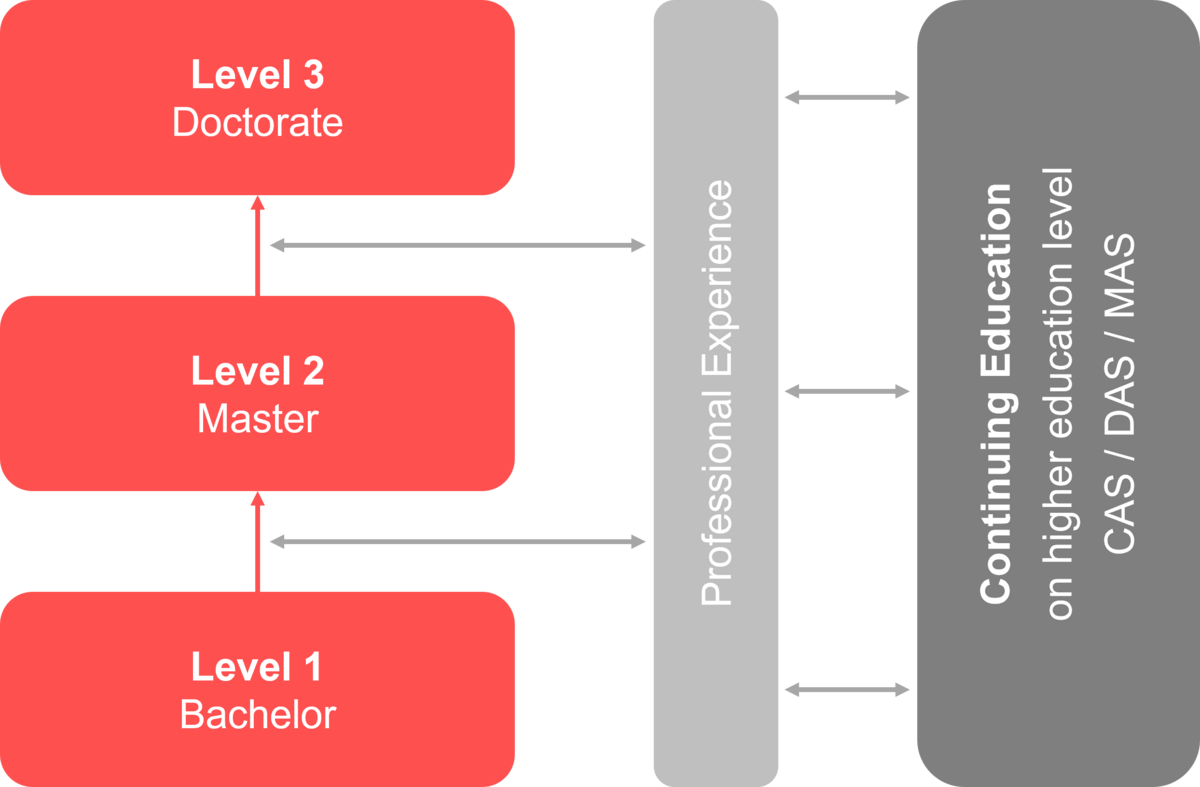 Swiss Higher Education Qualifications Framework (Source: swissuniversities)
Higher Tuition Fees and Selective Admission Requirements
Compared with traditional academic Master’s programmes such as MSc or MA programmes, MAS programmes are commonly positioned as advanced professional education for working professionals. Tuition fees and admission requirements may vary depending on the institution, programme field, delivery model, and institutional status. In many cases, applicants are expected to demonstrate both prior academic preparation and relevant professional experience.
MAS as a Continuing Education Qualification
MAS is practice-oriented and competence-focused, rather than primarily research-oriented. It belongs to the category of further education and continuing professional education and should not be presented as a consecutive Bologna Master’s degree. MAS qualifications do not automatically grant admission to academic PhD studies. Progression to doctoral studies, where applicable, remains subject to the admission policies and academic decisions of the receiving institution.
The value and recognition of an MAS depend on the awarding institution, its legal status, accreditation position, programme structure, and the context in which the qualification is assessed. In professional settings, MAS qualifications are often used to demonstrate advanced applied competence, executive capability, and specialised professional development.
Swiss ENIC and MAS Evaluation
Swiss ENIC does not issue level certificates for postgraduate or continuing education qualifications such as MAS, DAS, and CAS, as these programmes cannot be assessed due to a lack of comparison criteria in the national and international environment. This should not be interpreted as a negative judgement on the value of MAS, but rather as a limitation of the Swiss ENIC evaluation scope.
SwissUK® – Adding an International Competency-Referencing Layer
SwissUK® is designed to support the international positioning of Swiss application-oriented education by combining the Swiss MAS model with pathways aligned to the UK Regulated Qualifications Framework, where applicable. This allows learners’ competencies to be presented through a more transparent and internationally understandable reference framework.
SwissUK® preserves the professional and application-oriented nature of MAS and does not transform MAS into a conventional academic Master’s degree. Instead, it adds an international competency-referencing layer that may support transparency, comparability, and professional communication with employers, institutions, and relevant authorities, subject to their own assessment requirements.
Principles for Credit Transfer from SwissCAS⁺ to Swiss MAS (Master of Advanced Studies) by SwissUK®
1. Credit Accumulation Principle
SwissCAS⁺ is designed according to an independent module model with reference to the Swiss Hochschulweiterbildung / higher education continuing education approach. Credits obtained from SwissCAS⁺ may be accumulated and considered for transfer into the Swiss MAS programme if:
- The module belongs to the same professional field or an approved interdisciplinary field
- The learning content meets the learning outcomes of the MAS programme
- The credit accumulation period remains valid
- The credits are properly documented and verifiable within the SwissUK® academic system
2. Academic Alignment Principle
Credit transfer is assessed based on:
- Equivalent academic or professional level
- Learning outcomes
- Equivalent ECTS credit volume or recognised learning workload
- Workload, assessment requirements, and content depth
- Relevance to the intended MAS programme pathway
The Academic Council of SwissUK® has the authority to determine the level of recognition in accordance with SwissUK® academic regulations.
3. Transfer Application Portfolio
Learners applying for credit transfer must submit the following documents:
Copy of the SwissCAS⁺ certificate
- Transcript or official confirmation of learning results
- Assignments, projects, or applied research work completed
- Assessment results with comments, if available
- Any additional evidence required by the Academic Council
The portfolio must be verified in the official academic system of SwissUK® before any credit transfer decision is confirmed.
4. Transfer Limit
- A maximum of 60 ECTS or equivalent learning credits may be considered for transfer from SwissCAS⁺ into the Swiss MAS programme, subject to academic review and programme requirements.
- In all cases, learners must complete the required final component of the MAS at SwissUK®, such as the Capstone, final project, applied research project, or final assessment, as prescribed by the programme regulations.
- Credit transfer does not reduce or waive any mandatory final assessment required for the award of the MAS qualification.
5. Validity Period
SwissCAS⁺ credits are valid for transfer consideration for a maximum period of two years from the date of completion, unless otherwise determined by the Academic Council.
6. Credit Eligibility and Academic Integrity Principle
Only credits that are:
- Completed directly within the SwissUK® system;
- Verified and stored in the official SwissUK® academic system; and
- Assessed in accordance with SwissUK®
academic standards are eligible for transfer.
Credit transfer from external providers or programmes not approved or recognised within the SwissUK® academic system will not be accepted.
7. Award Integrity Principle
Credit transfer does not mean the automatic award of the MAS qualification.
Learners must:
- Complete the total number of credits required by the MAS programme
- Meet the final programme assessment standards
- Complete the required Capstone, final project, applied research project, or final assessment
- Satisfy all academic, administrative, and award requirements prescribed by SwissUK®
The MAS qualification is awarded only after the learner has fulfilled all programme completion requirements and the award has been approved through the official academic decision-making process of SwissUK®.
Principles for Tuition Fee Credit toward the Swiss MAS (Master of Advanced Studies) Programme by SwissUK®
SwissCAS⁺ is designed as a progression pathway, allowing eligible learners who continue to the Swiss MAS programme to receive a corresponding internal tuition fee credit, subject to academic and financial approval.
1. Tuition Fee Credit Principle
A portion of the tuition fee paid for SwissCAS⁺ may be credited toward the tuition fee of the Swiss MAS programme if:
- The learner registers for the MAS within the valid progression period
- SwissCAS⁺ credits are recognised toward the MAS
- The learner has completed all prior academic and financial obligations
- The learner meets the applicable progression requirements of SwissUK®
The tuition fee credit is not automatic and must be officially reviewed and approved.
2. Scope of Tuition Fee Credit
- Only the portion of tuition corresponding to recognised credits may be considered for tuition fee credit
- Administrative fees, application fees, review fees, certificate issuance fees, or additional service fees are not included in the tuition fee credit scope
- The total tuition fee credit must not exceed the limit set by SwissUK® at the relevant time
- The applicable amount will be determined according to the official tuition policy, admission confirmation, or fee schedule issued for the relevant intake
3. Applicable Period
The tuition fee credit policy is valid for a maximum period of 24 months from the date of completion of SwissCAS⁺, unless otherwise announced or approved by SwissUK®.
4. Non-Refund Principle
Tuition fee credit does not constitute a cash refund, cash transfer, or withdrawal of previously paid tuition.
The credited value applies only as an internal tuition credit when the learner registers for the Swiss MAS programme and is subject to the applicable tuition policy at the time of progression.
5. Decision-Making Authority
SwissUK® reserves the right to:
- Adjust the tuition fee credit rate according to each intake or programme policy
- Refuse the tuition fee credit if academic, administrative, or financial conditions are not met
- Update the policy to ensure academic quality, financial sustainability, and consistency with the SwissUK® progression model
- Determine the final applicable credit amount through its official academic and financial approval process
6. Transparency Principle
All approved tuition fee credits will be:
- Clearly stated in the MAS admission confirmation letter or official progression document
- Clearly recorded on the tuition invoice or payment schedule
- Stored in the official financial records of SwissUK®
- Applied only after formal approval has been completed
7. No Automatic Entitlement
Participation in SwissCAS⁺ does not automatically guarantee tuition fee credit toward the Swiss MAS programme.
The tuition fee credit is granted only when the learner satisfies the relevant academic, administrative, financial, and progression requirements prescribed by SwissUK®.


SwissCAS⁺
Frequently Asked Questions
SwissCAS⁺ – Certificate of Advanced Studies credits may be considered for transfer toward the Master of Advanced Studies (MAS) programme, together with a corresponding internal tuition fee credit, subject to academic and financial approval.
What is SwissCAS⁺?
SwissCAS⁺ (Certificate of Advanced Studies) is a Swiss-style postgraduate continuing education certificate programme with reference to the Hochschulweiterbildung / higher education continuing education model. It is owned and delivered by Swiss Information and Management Institute within the SwissUK® academic ecosystem.
Hochschulweiterbildung refers to a postgraduate continuing education pathway for individuals who have completed a university degree or possess equivalent professional experience.
This pathway includes the following levels:
CAS (Certificate of Advanced Studies) → DAS (Diploma of Advanced Studies) → MAS (Master of Advanced Studies) → DRAS (Doctoral Advanced Studies)
Entry Requirements for SwissCAS⁺
Applicants must meet one of the following requirements:
1. Hold a Bachelor’s degree, tertiary-level qualification, or equivalent academic/professional qualification;
or
2. Have relevant professional experience and be approved by the SwissUK® Academic Council under an alternative admission route, subject to SwissUK® admission regulations.
In addition:
- Applicants must have a professional background relevant to the intended field of study.
- In special cases, applicants may be required to attend an interview or submit a competency portfolio for further assessment.
After completing SwissCAS⁺, can learners progress to MAS?
Yes, and this is one of the distinctive features of this system.
Credits earned from SwissCAS⁺ may be considered for transfer toward the Swiss MAS (Master of Advanced Studies) programme, subject to academic review and official approval.
MAS is a recognised Swiss-style continuing education qualification, designed with an application-oriented and professional development focus.
Is tuition fee credit available when progressing to MAS?
Yes. A portion of the tuition fee may be applied as an internal tuition fee credit when registering for the Swiss MAS, in accordance with the policy applicable at the time and subject to official approval.
How long does SwissCAS⁺ take to complete?
SwissCAS⁺ normally takes 3–6 months to complete, depending on the programme structure, study schedule, and learner progression.
Who is SwissCAS⁺ suitable for?
SwissCAS⁺ is suitable for managers and professionals who wish to obtain a Swiss-style postgraduate continuing education certificate for practical workplace application. It is also suitable for learners who want to build a progression pathway toward MAS or DRAS within the SwissUK® academic ecosystem, subject to academic requirements and approval.
REGISTER FOR A 1:1 CONSULTATION
We understand that you need in-depth and personalized information tailored to your specific goals. Please provide your details, and we will contact you shortly. All of your information will be kept strictly confidential.
SwissCAS⁺ – Certificate of Advanced Studies by SIMI
Swiss Information and Management Institute
SIMI Swiss
Blegistrasse 7, 6340 Baar, Switzerland
• Phone: +41 76 236 28 84
• support@simiswiss.ch